Process··8 min read
Hire a Canal Dredging Contractor in Palm Beach County
Hiring a canal dredging contractor in Palm Beach County is easier when you know what to ask. Learn how to compare licenses, equipment, permits, disposal plans, and written scopes.
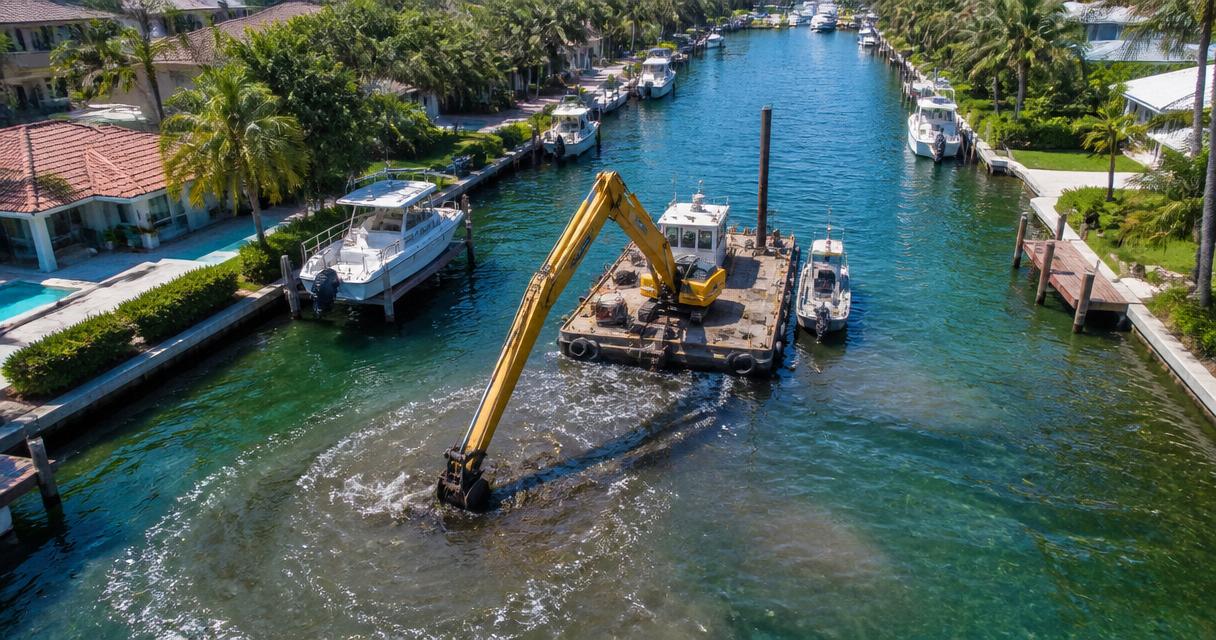
A good canal dredging contractor does more than move sediment. The right partner protects your dock, seawall, boat access, neighbors, permits, and budget. When you understand the basics ahead of time, it is much easier to compare quotes, ask the right questions, and choose a contractor who fits your specific project.
In Palm Beach County, canal dredging is especially local. Conditions vary from Boca Raton and Delray Beach to Boynton Beach, West Palm Beach, Palm Beach Gardens, Jupiter, and nearby Fort Lauderdale. Some canals are narrow and residential. Others are tidal, sandy, mucky, or limited by bridge clearance. Before you sign a dredging contract in 2026, use this checklist to make a confident, informed hiring decision.
1. Verify licensing, insurance, and marine contractor experience
Start with the basics: the contractor should be properly licensed for marine construction or dredging work in Florida and able to provide current insurance certificates before mobilization. Ask for proof of general liability, workers compensation, and marine-related coverage if barges, workboats, or floating equipment will be used.
It helps to ask for specific details: license number, certificate dates, and coverage limits. That makes it easier to compare quotes on equal footing. For residential canal work in Palm Beach County, many qualified contractors carry at least $1 million in general liability coverage, and larger commercial or HOA projects may require more.
Palm Beach Dredging is a licensed Florida marine contractor and a division of South Florida Seawall, which gives waterfront owners one team for dredging, seawall coordination, dock access, and related marine site conditions. That matters when shallow water is connected to aging seawalls, undermined caps, or restricted access.
2. Match the equipment to your canal, not the other way around
Dredging equipment should fit the site. A contractor working behind a home in Boca Raton may need compact barges, long-reach excavators, hydraulic pumps, turbidity curtains, and low-impact staging. A wider canal or marina basin in West Palm Beach may require different production equipment and larger spoil handling capacity.
Ask what equipment will be used and why. Mechanical dredging with an excavator and barge can be effective for thicker sediment, debris, and confined areas. Hydraulic dredging can move material through pipe to a dewatering location but requires suitable staging and discharge control. Some jobs need both.
The key question is not which method sounds best. The key question is which method reaches the target depth safely, protects nearby seawalls and docks, and handles the material legally. If you are still deciding whether dredging is necessary, start with signs your canal needs dredging.
3. Confirm who handles permits and agency coordination
Canal dredging in Palm Beach County may involve local municipalities, Palm Beach County, the Florida Department of Environmental Protection, water management districts, the U.S. Army Corps of Engineers, or HOA and community approvals. The exact permit path depends on location, waterway connection, volume, habitat, mangroves, and whether work is maintenance dredging or new excavation.
A qualified contractor should be able to explain the likely permit route before work begins. They should also know when an environmental consultant or surveyor is needed. If someone says no permit is needed without reviewing the address, waterway, proposed depth, and disposal plan, ask them to confirm that in writing or double-check with the agency directly.
Permitting can take a few weeks for simple maintenance work or several months for more complex sites. For a deeper breakdown, read our guide to canal dredging permits in Palm Beach County.
4. Get a written scope, survey, and target depth
A clear quote helps everyone. A written scope should define the work area, existing depth information, target depth, estimated volume, access route, equipment, spoil handling, disposal method, permit responsibility, schedule, exclusions, and payment terms.
For many projects, a pre-dredge depth survey or soundings are used to estimate how much material needs removal. A post-dredge verification may also be recommended, especially for HOAs, marinas, shared canals, and properties with repeated grounding at low tide.
Pricing may be based on cubic yards, day rates, lump sum scope, mobilization, disposal, or a combination. In Palm Beach County, small residential jobs can be heavily affected by mobilization and disposal logistics, while larger canal projects may benefit from production efficiency. Review our Palm Beach canal dredging cost guide before comparing numbers.
5. Ask these questions before signing
Clear questions lead to clear answers. A good contractor will welcome them because they show you are serious about the project.
Questions to ask
- Are you licensed for this type of marine work in Florida?
- Can you provide current insurance certificates before mobilization?
- What dredging method are you recommending and why?
- How will you protect my seawall, dock, lift, utilities, and neighboring properties?
- Who is responsible for permits, drawings, surveys, and agency communication?
- What is the target depth and how will it be confirmed?
- Where will dredged material go, and is that disposal site approved?
- What happens if the actual sediment volume is higher than estimated?
- How long will mobilization, dredging, dewatering, cleanup, and demobilization take?
- What is excluded from the price?
Get the answers in writing so both parties have the same expectations. This protects everyone and helps the project run smoothly.
6. Compare bids on scope, not just price
The lowest dredging estimate is not always the best fit. A bid that leaves out mobilization, disposal, dewatering, or permit support can create gaps later. Look for a complete scope: license details, insurance, disposal location, permit discussion, target depth, and an explanation of how sediment volume was estimated.
Payment terms should also be clear. A standard contract usually ties payments to milestones, not a large upfront deposit. The disposal method should be named and approved. If permits are your responsibility, the quote should say so before the work starts. If the permit path is not yet defined, the contractor should outline the next steps rather than guess.
Marine dredging is a specialty. Working from land is different from working in tidal canals around seawalls, docks, lifts, mangroves, manatees, turbidity controls, and tight waterfront access. Ask how the contractor has handled similar conditions and whether they can adapt the method if the site changes once work begins.
7. Choose a contractor with true local knowledge
Local experience matters because every city has different access constraints and review habits. In Boca Raton, many canals are residential and lined with seawalls, boat lifts, and narrow side yards. In Delray Beach and Boynton Beach, staging and neighborhood coordination can drive the schedule. In Jupiter, tidal influence, environmental sensitivity, and waterfront access often shape the method. In Fort Lauderdale, bridge clearance, dock density, and marine traffic can change equipment selection.
A local contractor should understand where equipment can launch, how to coordinate with waterfront residents, how tides affect production, and when dredging should be sequenced with seawall or dock repairs. As part of South Florida Seawall, Palm Beach Dredging can look at the full shoreline condition, not just the sediment.
8. Confirm safety, turbidity control, and legal disposal
Dredged material has to go somewhere. That somewhere should be legal, documented, and included in the quote. Depending on the sediment and project type, material may be placed in a barge, hauled to an approved upland site, pumped to a dewatering area, or handled through another permitted method.
Ask how the contractor will manage turbidity, floating debris, work zones, and boat traffic. Turbidity curtains may be required or recommended. Crews should have a plan for fuel handling, spill response, equipment access, and daily cleanup. If the canal remains active during work, the contractor should explain how boaters, neighbors, and workers will be protected.
A well-run dredging project is not just about the final depth. It is about leaving the property safe, the waterway compliant, and the owner with records that support what was done.
Ready to talk about your canal dredging project?
If you are dealing with shallow water, prop wash, muck buildup, blocked boat access, or repeated low-tide grounding in Palm Beach County, get the site evaluated before guessing at the fix. Palm Beach Dredging provides local canal dredging assessments backed by the marine construction experience of South Florida Seawall.
Schedule a free site survey and speak with a licensed Florida marine contractor. Call 754-SEA-WALL or contact Palm Beach Dredging to review your canal, access, permitting path, disposal options, and a written scope for the work.
Frequently asked questions
- Does a canal dredging contractor in Palm Beach County need a license?
- Yes. Canal dredging is marine construction work and should be performed by a properly licensed Florida marine contractor or qualified contractor with the correct local authority for the scope. Ask for the license number and verify it before signing.
- What insurance should a dredging contractor carry?
- At minimum, ask for current general liability and workers compensation certificates. For barge, boat, or floating equipment work, ask whether marine liability or related coverage applies. Many residential projects look for at least $1 million in liability coverage.
- Who is responsible for dredging permits?
- This should be stated in the contract. A qualified contractor can usually help identify the permit path and coordinate with agencies, but some projects also need surveys, drawings, HOA approvals, or environmental support. Ask for confirmation in writing if permits are included in the scope.
- How much does canal dredging cost in Palm Beach County?
- Cost depends on mobilization, access, depth, sediment volume, equipment, disposal distance, permits, and dewatering needs. Small residential jobs may cost more per cubic yard because mobilization is fixed, while larger shared canal projects can be more efficient.
- How long does a typical canal dredging project take?
- Field work for a small residential canal section may take a few days to a couple of weeks after permits and mobilization. Permitting and scheduling can add several weeks or months depending on agencies, environmental conditions, and disposal planning.
- Where does dredged material go after removal?
- Dredged sediment must be handled through a legal disposal or dewatering plan. It may be barged, pumped, dewatered, or hauled to an approved upland location depending on the project. The disposal method and responsibility should be included in the written scope.